The Petrified Forest of Arizona: A Window into the Triassic
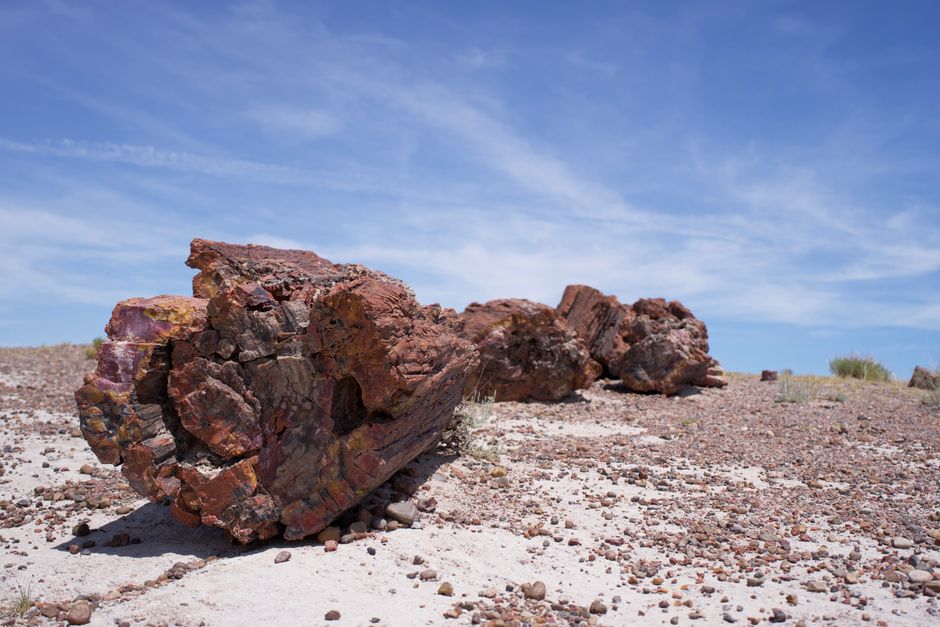
The Petrified Forest National Park in Arizona offers a unique perspective on deep time, preserving a landscape from the Late Triassic period, approximately 225 million years ago. This region, now arid and high desert, was once a lush, riverine environment inhabited by early dinosaurs, giant amphibians, and towering conifers. The park’s most striking feature is its vast deposits of fossilized wood, brilliant in hues of red, yellow, and purple, which lie scattered across the badlands. These logs are not merely curiosities; they are scientific records that provide insight into ancient ecosystems, climates, and geological processes. By examining these fossils, researchers can reconstruct conditions that existed long before the rise of modern continents, offering a glimpse into a world that is both alien and foundational to our own.
The process that transformed these trees into stone is a remarkable interplay of burial, mineral-rich water, and time. Unlike ordinary fossils, which often preserve only the shape or imprint of an organism, petrified wood retains its original internal structure in exquisite detail. This preservation occurs when wood is buried rapidly by sediment, cutting off oxygen and slowing decomposition. Groundwater saturated with silica then permeates the wood, and over millions of years, the organic material is replaced cell by cell with silica, often in the form of quartz. The result is a faithful mineral replica of the original trunk, complete with growth rings and cellular structures. This process, known as permineralization, is central to the park’s paleontological significance, as it allows scientists to study the anatomy of ancient trees and infer aspects of their growth and environment.
The climate of the Late Triassic was vastly different from what we experience today. Global temperatures were higher, and the supercontinent Pangaea dominated the Earth. The region that is now the American Southwest lay near the equator, characterized by a strong monsoonal climate with pronounced wet and dry seasons. The enormous trees found in the park, such as the conifer Araucarioxylon arizonicum, grew rapidly in these conditions, reaching heights of up to 60 meters. Their annual growth rings, visible in cross-sections of the fossils, provide a record of seasonal rainfall patterns. Some rings are wide, indicating years of abundant moisture, while others are narrow, suggesting drought. This tree-ring data, analogous to dendrochronology on modern wood, offers a window into the variability of ancient climates. Furthermore, the presence of other fossils, such as ferns, cycads, and early reptiles, paints a picture of a diverse, riverine ecosystem that was likely subject to periodic flooding and volcanic ashfalls, which contributed to the rapid burial that favored fossilization.
The Geology of Petrification
The geological history of the Petrified Forest is a story of sedimentation and volcanic activity. The park is part of the Chinle Formation, a thick sequence of sedimentary rocks that spans much of the Late Triassic. This formation was deposited by vast river systems that flowed across the floodplains of Pangaea, carrying sediments from ancestral highlands to the west. The petrified logs are found within a layer known as the Sonsela Member, which is characterized by sandstones and conglomerates that indicate a dynamic, braided river environment. Volcanic activity in the region, part of a magmatic arc to the south and west, played a crucial role. Ashfall from these volcanoes blanketed the landscape, providing a source of silica-rich soil and groundwater. When trees were buried by river sediments and ash, the percolating groundwater dissolved this silica and carried it into the porous wood, where it precipitated to form quartz. The interplay between sediment deposition, volcanic input, and groundwater chemistry determined the quality and color of the petrification. For instance, trace amounts of iron oxides and other minerals impart the vivid reds, oranges, and blues that make the park’s fossils so visually striking.
Unearthing the Triassic Ecosystem
The fossilized wood of the Petrified Forest is not an isolated phenomenon; it is part of a rich fossil record that includes plants and animals. Paleontologists have uncovered a variety of fossilized plant remains, including leaves, cones, and seeds, which help reconstruct the flora of the Late Triassic. The dominant trees were conifers, but there were also ginkgoes, cycads, and ferns, forming a canopy that would have resembled a modern subtropical forest. The animal life included early dinosaurs, such as the small, bipedal Coelophysis, as well as large amphibians like Metoposaurus, and a variety of reptiles. These organisms were adapted to the seasonal climate, likely migrating or burrowing during dry periods. The presence of fossilized burrows and trackways provides further evidence of behavioral adaptations. By studying these fossils, scientists can piece together the food web and ecological interactions of this ancient world. Moreover, the remarkable preservation of some specimens, including skin impressions and stomach contents, offers rare glimpses into the biology and behavior of these species, allowing for more nuanced interpretations of their life histories.
Scientific Methods and Research
Modern research in the Petrified Forest employs a range of techniques to extract information from these fossils without damaging them. Non-destructive methods, such as CT scanning and 3D imaging, allow researchers to examine internal structures without cutting or removing samples. This is crucial for studying rare or fragile specimens. Geochemical analyses, including stable isotope analysis, can provide insights into the temperature and precipitation patterns at the time the trees were alive. By measuring the ratios of oxygen and hydrogen isotopes in the quartz that replaced the wood, scientists can infer aspects of the ancient water cycle. Additionally, magnetostratigraphy, the study of magnetic field reversals recorded in the rocks, helps date the layers and correlate them globally. These techniques, combined with detailed field observations, enable a comprehensive understanding of the environment and its changes over time. However, research is ongoing, and many questions remain, particularly regarding the exact rates of petrification and the influence of microbial activity in the process.
Conservation and Preservation Challenges
The Petrified Forest National Park faces significant conservation challenges. The fossilized wood is fragile and subject to natural weathering, but human activities pose a greater threat. Despite its status as a protected area, theft of petrified wood remains a problem, with visitors illegally removing specimens. The park’s management implements education and enforcement strategies to mitigate this, but the remote nature of the park makes monitoring difficult. Additionally, erosion and climate change are altering the landscape, potentially exposing fossils to degradation or burying them further. To address these issues, the park uses a combination of patrols, surveillance, and public awareness campaigns. Researchers also work to document and catalog fossils, creating digital records that can be studied even if physical specimens deteriorate. For visitors, the park offers opportunities to see fossils in situ, but strict regulations prohibit collecting. By balancing scientific research, public education, and protective measures, the park aims to preserve this geological treasure for future generations.
The Significance of the Petrified Forest
The Petrified Forest is more than a collection of beautiful stones; it is a key site for understanding the history of life on Earth. It provides a snapshot of a critical period in evolution, when dinosaurs were just beginning to dominate terrestrial ecosystems. The fossils also serve as a natural laboratory for studying processes like fossilization and diagenesis, which have broader implications for geology and biology. Furthermore, the park’s landscapes, with their colorful badlands and ancient logs, offer a tangible connection to deep time, inspiring curiosity and appreciation for the natural world. For scientists, the Petrified Forest is a vital resource that continues to yield new discoveries. For the public, it is a place where the scale of geological time becomes tangible. As research methods improve and new questions emerge, this site will undoubtedly remain a focus of scientific inquiry, providing insights not only into the Triassic but also into the dynamic processes that shape our planet.